

Description
To flow through the smallest capillaries, red blood cells must be highly deformable. In pathologies such as sickle cell anemia and spherocytosis, this ability is altered. Cell deformability is therefore a relevant parameter to diagnose and monitor these diseases, but how can it be measured? We use molecular rotors, fluorescent probes whose signal depends on local viscosity [1], to measure the mechanical properties of single cells [2-3]. The challenge is a physical one: understanding how the rotors interact with the cell [4], and relating their fluorescence signal to well-defined physical parameters.
Download the full announcement (PDF)
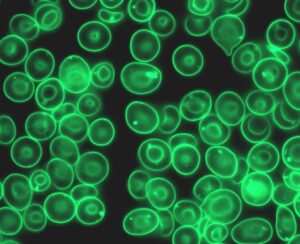
Red blood cells labeled with a fluorescent probe
What you will do
- Understand how molecular rotors interact with red blood cells
- Relate the rotor fluorescence signal to quantitative physical parameters
- Compare healthy and pathological red blood cells to identify mechanical signatures of disease
- Build your own Python pipeline to turn fluorescence images into quantitative measurements
Why it matters
Current clinical methods cannot sensitively detect the altered deformability of red blood cells in disease. Your physical measurements could provide new biomarkers for patient monitoring.
Research environment
You’ll work at Matière et Systèmes Complexes, a soft matter lab with state-of-the-art fluorescence microscopy and microfluidics, in collaboration with biologists (BIGR) and clinicians at Necker Hospital.
What you will learn
Quantitative fluorescence microscopy, image analysis and statistical data analysis, and how to take a physical measurement from the bench to a biological question.
Candidate profile
Master’s student with a taste for soft matter, statistical physics or biophysics, and for experiments. Programming skills (Python or MATLAB). No background in biology required.
Outlook
This internship can lead to a PhD thesis.
To apply
Send your CV to Dr. Bérengère Abou: berengere.abou@gmail.com
- F. Di Scala, A. Briole, V. Myndrul, T. J. Cleij, H. Diliën, B. Abou & B. van Grinsven, Molecular rotors: from Newtonian fluids to functional materials as viscosity and temperature sensing tools, Adv. Funct. Mater., e77541 (2026).
- A. Briole, T. Podgorski & B. Abou, Molecular rotors as intracellular probes of red blood cells rigidity, Soft Matter 17, 4525 (2021).
- A. Briole, M. Marin, C. Le Van Kim & B. Abou, Using molecular rotors to investigate hemoglobin concentration and heterogeneity in red blood cells, J. Rheol. 69, 463 (2025).
- A. Briole & B. Abou, Molecular rotors in haemoglobin and bovine serum albumin proteins, J. R. Soc. Interface 19, 20220709 (2022).