
Keywords: Macroscopic Physics, Fluid Mechanics, Geomorphology, Morphogenesis, Chemical Physics
Internship location : Laboratoire MSC (Matière et Systèmes complexes).
Université Paris Cité. Bâtiment Condorcet, Paris 75013. Starting date: first semester of 2027, flexible.
Contact: Michael Berhanu (https://labo.msc.u-paris.fr/~berhanu )
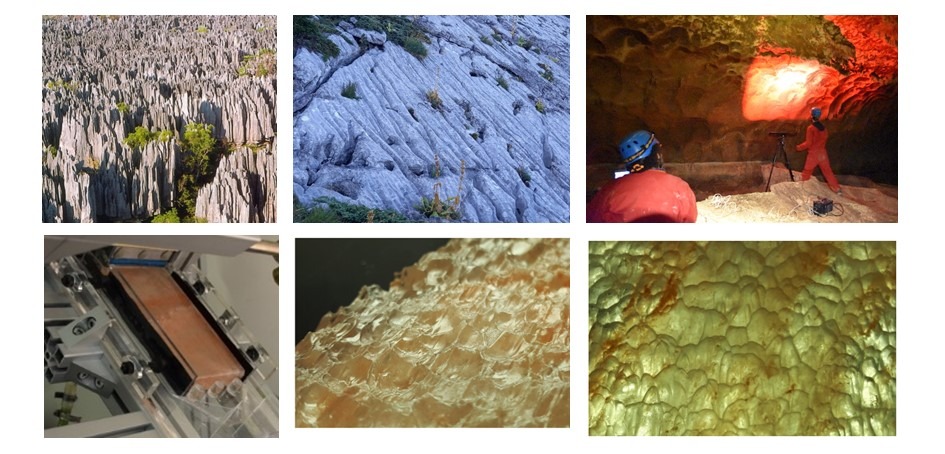
The internship can be followed in a PhD Research project starting in fall 2027. Subject: Landscapes are shaped under water flows and wind action, and the understanding of their morphodynamics requires the identification of the physical mechanisms at play. The processes of erosion of sediment composed of macroscopic grains have been extensively studied, which is not the case of the erosion by dissolution. However, this process plays a significant role in area covered by a soluble mineral like in Karst regions and is the cause of the formation of remarkable patterns [1] (limestone pavements, scallops, dissolution channels [2], dissolution pinnacles, limestone forests…) with characteristic length scales. We propose in this internship, by the mean of controlled laboratory experiments, to study the morphogenesis of dissolution patterns. The soluble media and the hydrodynamic flows will be tuned to downscale the characteristic size and time of the involved processes from geological values to “laboratory” values. Thanks to quantitative measurements of the flow and of the topography of eroded surfaces, we will identify the driving elementary physical mechanisms and thus develop mathematical models [3] and numerical simulations [4], with the aim to explain complex geological systems and to predict the long term evolution of landscapes. Field missions are performed to measure dissolution shapes in nature and to compare with models and experiments.
In this internship, the student will develop in the group, one or several model experiments, reproducing dissolution erosion phenomena. To decrease the timescales, fast dissolving materials like salt and plaster will be used. Hydrodynamic properties of the flows will be characterized and the 3D shape evolution of eroded surfaces will be recorded. Several experimental projects are possible, depending on the water flow configuration (thin film, turbulent current …).
References:
[1] S. Carpy, M. Berhanu, M. Chaigne, & S. Courrech du Pont. Comptes Rendus de l’Académie des
Sciences, Physique (2024). Fingerprints of surface flows on solid substrates ablated by phase change: from
laboratory experiments to planetary landscapes.
[2] A. Guérin, J. Derr and S. Courrech du Pont and M. Berhanu, Physical Review Letters, 125, 194502 (2020)
Streamwise dissolution patterns created by a flowing water film. (Editor’s choice).
[3] M. Chaigne, S. Carpy, M. Massé, J Derr, S. Courrech du Pont, & M. Berhanu,. Proceedings of the National
Academy of Sciences, 120(48), e2309379120 (2023), Emergence of tip singularities in dissolution patterns.
[4] J. Philippi, M. Berhanu, J. Derr and S. Courrech du Pont, Physical Review Fluids, 4, 103801 (2019)
Solutal convection induced by dissolution
[5] C. Cohen, M. Berhanu, J. Derr and S. Courrech du Pont, Physical Review Fluids, 5, 053802 (2020)
Buoyancy-driven dissolution of inclined blocks: Erosion rate and pattern formation.