

Vittore Scolari
Institut Curie, Paris
Abstract :
Chromatin is a complex of DNA, RNA and protein responsible for condensing and packaging chromosomal DNA in the cell nucleus. It is organized so that the essential processes governing genetic material can occur in a coordinated and orderly way. At the same time, chromatin is a polymer operating at submicroscopic scales, where its behaviour is strongly shaped by physical forces, including the constant stochastic fluctuations produced by thermal motion. In this talk, I will present recent work aimed at understanding how chromatin structure emerges from these biological and physical constraints. First, I will discuss how macromolecular crowding influences chromatin conformation [1,2]. I will then examine the factors shaping telomere organisation in yeast along the growth cycle, focusing on the interplay between phase separation and surface wetting [3]. Finally, I will present unpublished results from a machine-learning reanalysis of chromatin conformation dynamics across the cell cycle, showing how studying what current models struggle to explain can reveal relevant biological questions. I will conclude by proposing a framework that investigates chromosome organisation through the lens of physiology, this is complementary to the more traditional molecular biology approach that has long shaped this field of research.
1. A mean-field theory for predicting single polymer collapse induced by neutral crowders – PubMed
2. Compaction and swelling of single stretched DNAs driven by molecular crowding | bioRxiv
3. Esc1-mediated anchoring regulates telomere clustering in response to metabolic changes | bioRxiv

Screenshot
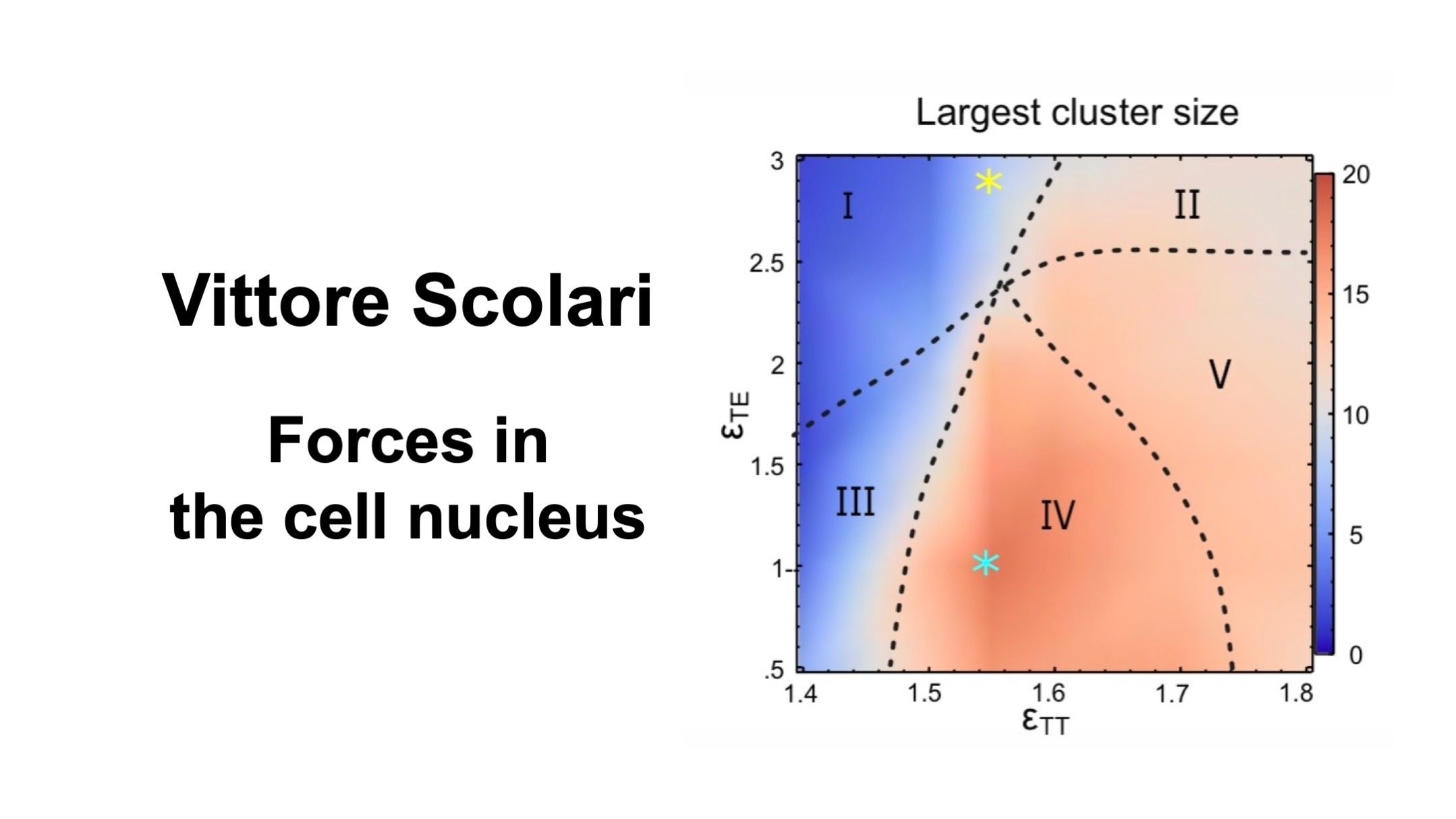
The picture shows the phase diagram of simulated yeast telomere clustering conformations as a function of attractive interactions between themselves (e_TT) and with the nuclear envelope (e_TE). Phases from I to V indicate: I: free telomeres at the nuclear envelope, II: clustering at the nuclear envelope, III: free telomeres in the bulk, IV: hypercluster formation, V: clustering in the bulk