

Grae Worster
Department of Applied Mathematics and Theoretical Physics, Centre for Mathematical Sciences, Cambridge, UK
The Dynamics of super-absorbent hydrogels
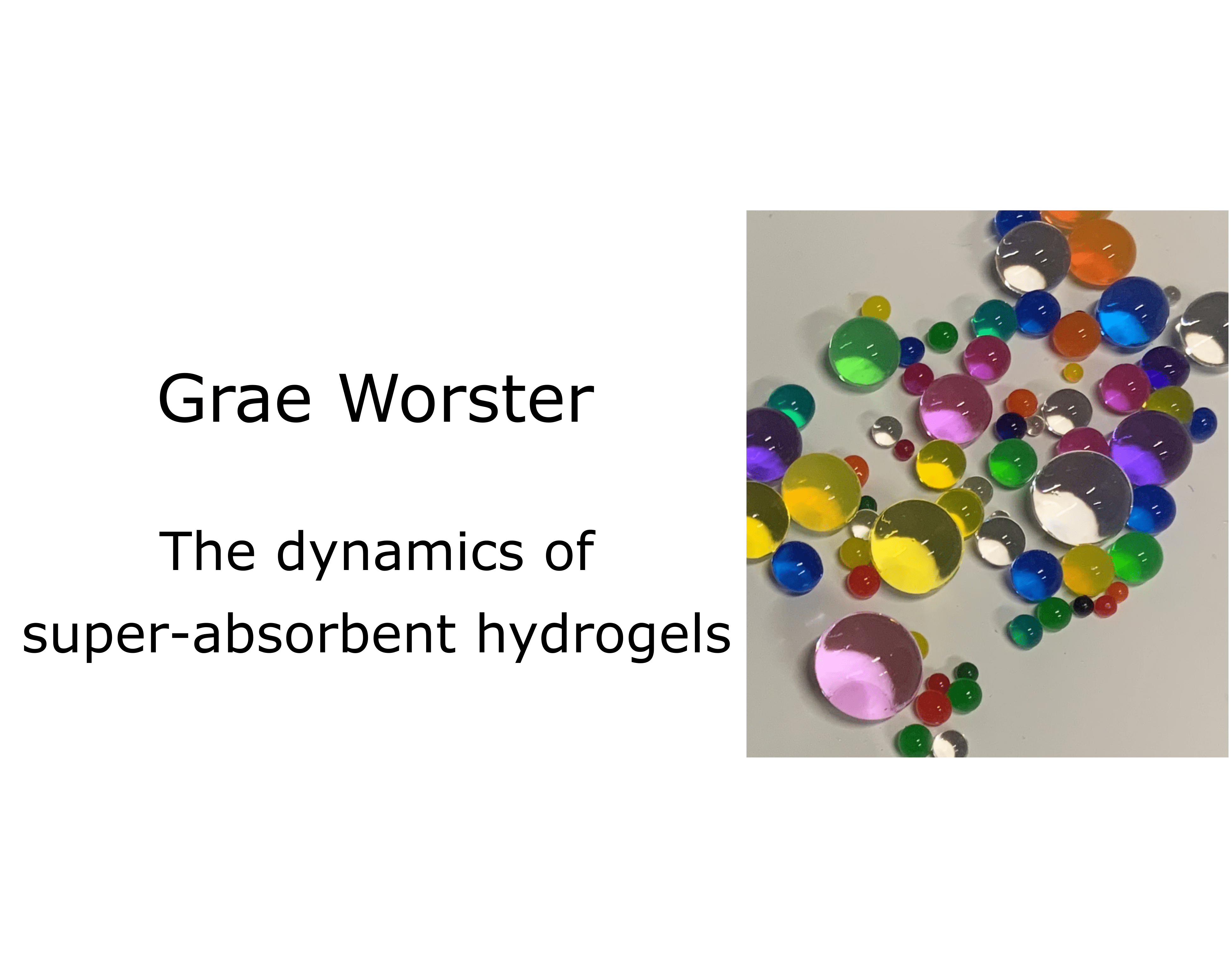
Super-absorbent polymers are used in disposable diapers, for soil remediation, for controlled drug delivery and as actuators in microfluidic devices. In fact, when placed in water they can form hydrogels with polymer fractions of less than 1% by volume, with the water molecules being adsorbed by the hydrophilic polymer to form an elastic material. The water is not fixed in place but can flow through the porous polymer scaffold to drive swelling and shrinkage. We have developed a new continuum-mechanical approach to modelling super-absorbent hydrogels, which allows for strongly nonlinear swelling while remaining linear in deviatoric strains, in effect treating hydrogels as instantaneously incompressible, linear elastic materials but with material properties that can vary strongly with polymer concentration. I will describe this model and illustrate its features by solving simple examples, including the swelling of spheres and transpiration through cylinders. Transpiration through hydrogel may provide a model for water transport through the stoma of plant leaves, for example.
