

Nirbhay Patil
Dynamical systems on highly heterogeneous networks
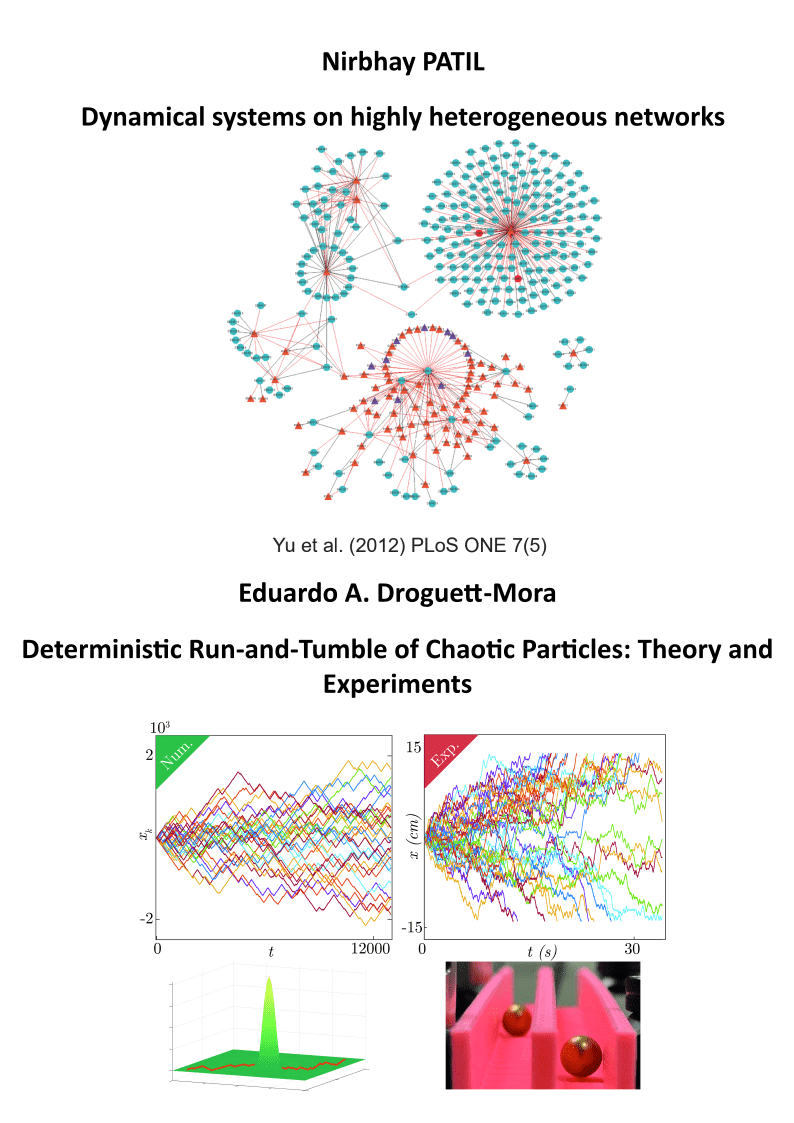
The idea of “six degrees of separation” states that any two people in the world are at most separated by six connections between them. This nature of human networks is also called a “small world network”, characterised by a power law distribution of network degrees. Such power laws are as ubiquitous in nature as in human systems, with population distributions, sizes of firms, wealth distributions, networks, etc, all often described best by this simple law. However, power laws are very difficult to deal with analytically, and a lot of theory often first discards the possibility of being in such a complicated regime. I’ll be presenting a new theoretical way to consider power law distributed networks in a way that is actually able to simplify complex dynamical systems, such as ecological or economical models.
Eduardo A. Droguett-Mora
Deterministic Run-and-Tumble of Chaotic Particles: Theory and Experiments
The “run-and-tumble” motion is a hallmark of bacterial and self-propelled particle dynamics. Traditionally, this is viewed as a stochastic process driven by random switching between two different propulsion modes: a ballistic one (run) and a sudden stop followed by reorientation (tumble). In this talk, we challenge this paradigm by presenting a minimal physical system that recovers this complex behavior through purely deterministic rules.
We explore the dynamics of localized structures that arise as inertial particle-like solutions within a two-dimensional dissipative system under a spatiotemporal forcing, modeled by the driven Turing-Swift-Hohenberg equation. A Newtonian-type description of these particles reveals that the interplay between inertia, dissipation, and the external forcing gives rise to this run-and-tumble behavior. We present a simple experiment that confirms our theoretical results, bridging biological behavior, extended physical systems, and classical mechanical dynamics, and providing a quantitative foundation for understanding deterministic run-and-tumble processes across diverse contexts.
