
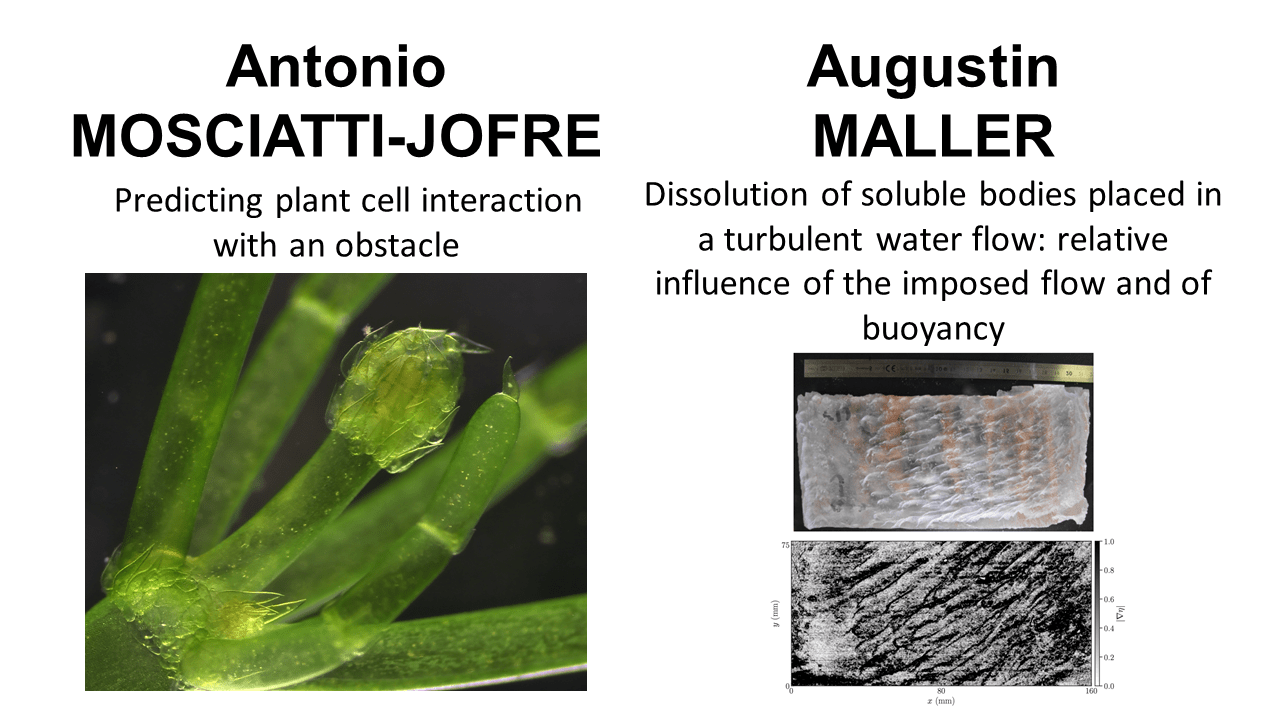
Intern Seminar : Antonio Mosciatti-Jofre and Augustin Maller
Abstracts below
Predicting plant cell interaction with an obstacle
Antonio Mosciatti-Jofre
Through turgor pressure, plant cells generate forces that far exceed those attainable by muscle contraction in animals. Maintaining turgor while growing involves a constant production of osmoticum to drive water into the cells, making it possible to pierce the soil and remain upright against the pull of gravity. Thus, water movements are key to understanding the different strains and stresses to which plant cells subject themselves. In the case of Characean internodal cells, the turgor pressure positively regulates the growth rate phenomenologically abiding to a threshold fluid like constitutive law, coined Lockhart’s law.
Ignoring other regulations, this framework provides one of the simplest descriptions of the interaction between a growing cell and its environment. Combining water potential equilibrium to Lockhart’s law, we quantitatively predicted how a growing cylindrical cell which exhibits elongation and twisting will interact with either a spring or a torsion spring. To test our predictions and evaluate our hypothesis robustness, we mounted an experimental set-up to monitor every quantity involved in Lockhart’s growth law and their evolution during the interaction between a single vegetal cell and a flat obstacle, in particular through the use of a pressure probe.
Dissolution of soluble bodies placed in a turbulent water flow: relative influence of the imposed flow and of buoyancy
Augustin Maller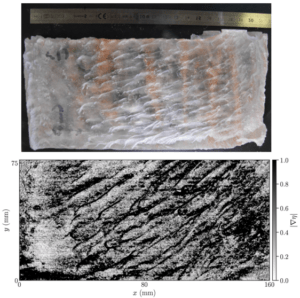
On the Earth’s surface, landscapes are shaped by erosion, whether mechanical or chemical. Chemical erosion, more specifically erosion by dissolution, is, for instance, the main mechanism for the erosion of limestone or gypsum. In the process, topography, flow, and solute transport interact, generating regular patterns whose size and shape depend on hydrodynamic conditions. Previous experimental studies have focused on the emergence of such patterns on the surface of rapidly dissolving materials in water, such as sucrose or salt. Without any imposed flow, dissolution of very soluble materials generates strong density gradients that can in turn generate a solutal convection flow, which affects the dissolution rate and the appearance of patterns. An imposed external flow also affect the local dissolution rate by shearing the solute boundary layer and thus influences the generation and the shape of dissolution patterns. Here, we examine the dissolution of salt plates in a turbulent flow of velocity ranging up to 0.6 m/s within a free-surface water flume. First, we focus on horizontal blocks. On the top face, the denser solute boundary layer is stable and the dissolution rate increases with the external flow velocity. Conversely, on the bottom face, the solute boundary layer is unstable in the presence of gravity, leading to the generation of a solutal convection flow through buoyancy effects, which competes with the external flow. While this flow is not strong enough to modify the dissolution rate significantly, we observe that the dissolution patterns become asymmetric indicating the direction of the external flow. Secondly, we consider salt blocks, which are inclined relative to the flow axis. In this more complex configuration, we study the orientation of dissolution patterns resulting from the competition between the external flow and the solutal convection.