

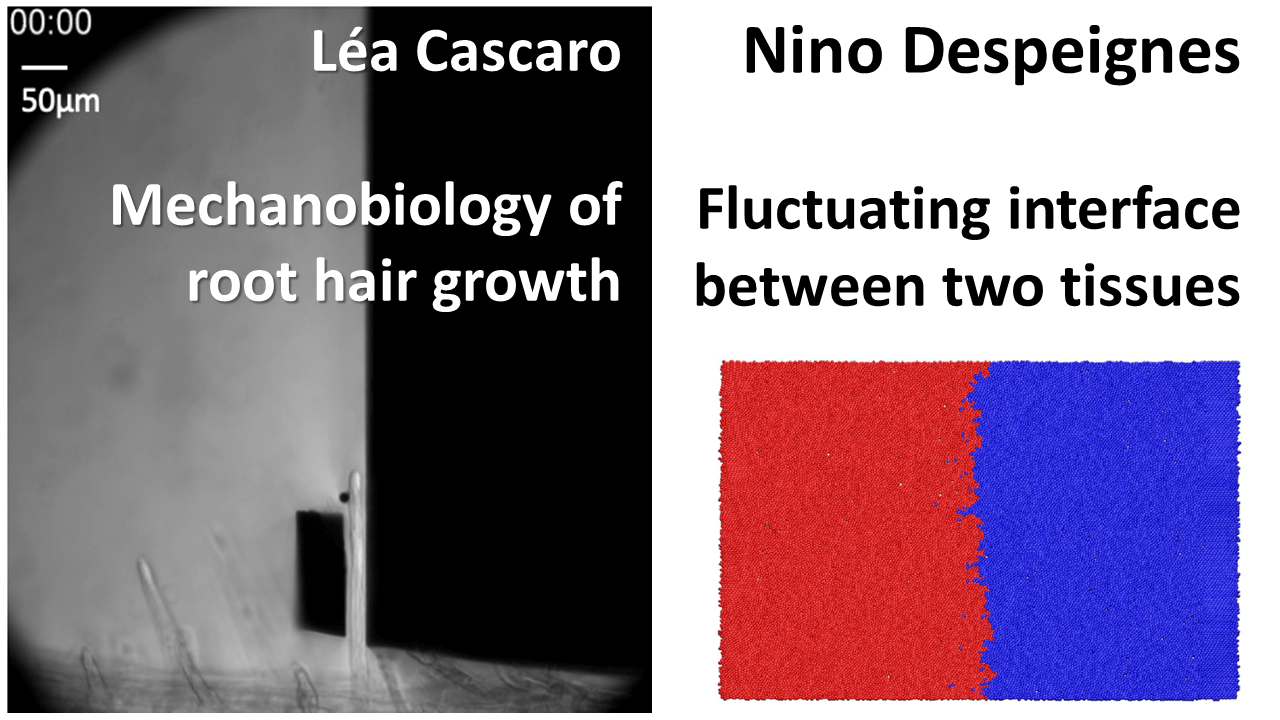
Intern Seminar : Léa Cascaro and Nino Despeignes
Abstracts below
Mechanobiology of root hair growth – Léa Cascaro
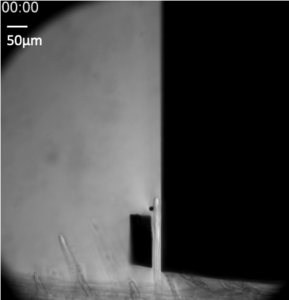
Root hairs are cylindrical protrusions that grow from a root epidermal cell. These protrusions allow the root to increase its surface of exchange with the soil, in particular increasing nutrients absorption. Root hairs exhibit a highly polarized tip-focused growth, called tip-growth. It allows the cell to explore and invade the soil. This process depends on turgor pressure, the hydrostatic pressure that provides the internal mechanical force driving cell expansion, and a heterogeneous cell wall, that allows the polarized growth. Thus, the tight coordination between turgor pressure and cell wall mechanical properties, such as the young modulus or tip viscosity, is essential for controlled root hair elongation. We are studying, experimentally, the link between all these mechanical parameters and their role in tip growth. To do so, we developed original setups which allow us to measure in a non-invasive way, on these single cells, the mechanical parameters characterizing root hair growth and their adaptation to environmental cues.
Fluctuating interface between two tissues – Nino Despeignes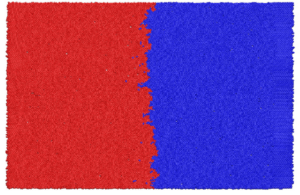
At large scales, hydrodynamics and elasticity based continuum approaches can be used to describe the mechanics and the dynamics of a tissue, harboring cell division and death. When two tissues are competing against each other, it has been shown that one invades the other in the form of a nonlinear front propagation problem. Our interest goes to the moving interface between the two tissues. We show that there exists an emergent surface tension independent of the original mechanics, driven by the steady cycle of birth and death at the cell level. At the linear relaxation level, the interface is shown to fluctuate in an Edwards-Wilkinson fashion, in spite of the nonlocal interactions mediated by the underlying hydrodynamics.