

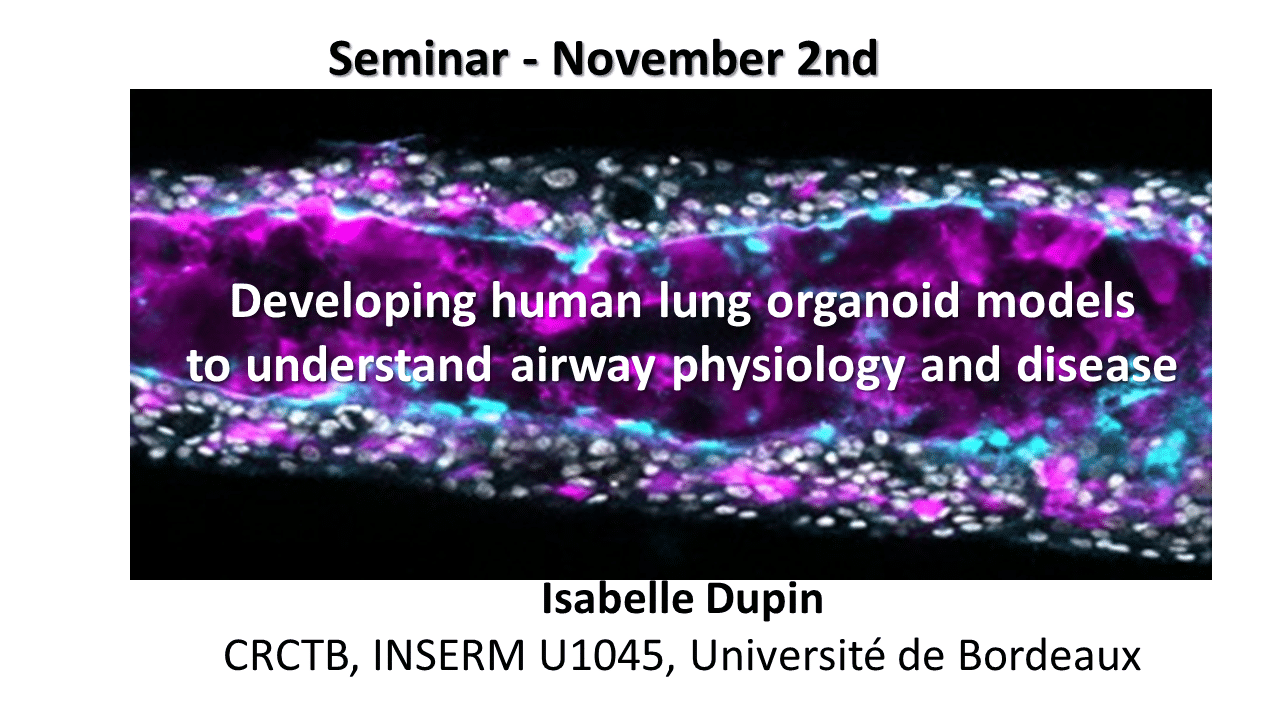
Developing human lung organoid models to understand airway physiology and disease
Isabelle Dupin, CRCTB, INSERM, Université de Bordeaux, France
The mammalian lung, which is essential for respiration, has a branched structure, the bronchial tree. In direct contact with the environment, the lung also acts as a barrier against external insults, such as pathogens and air pollutants. The mucociliary clearance system plays a key role in this defense by continuously removing inhaled particles and mucus from the airways. Alterations in mucus production and clearance can lead to mucus accumulation and the formation of mucus plugs, contributing to airway obstruction and ultimately to the development of respiratory diseases such as chronic obstructive pulmonary disease.
Lung organoid models are particularly attractive systems for studying lung physiology and disease. Initially consisting mainly of spherical epithelial structures, these models are becoming increasingly complex through the incorporation of additional cell types and the development of more diverse architectures. I will introduce their development from adult stem cells, as well as their applications in biomedical research, particularly for disease modelling. I will present an example of a tubular organoid modelling the distal bronchus, in which we can investigate the role of epithelial–mesenchymal interactions in maintaining the stem cell niche. I will also briefly discuss a mathematical model of mucociliary clearance that we have developed in collaboration with mathematicians to investigate the dynamics of mucus transport and the formation of mucus plugs.