

What can we learn from bacteria (about aging) and teach bacteria (about organelles)?
Ariel B. Lindner
Systems Engineering and Evolution Dynamics INSERM team, Computational, Quantitative and Synthetic Biology Dept., IBPS and Paris Biofoundry, CNRS, Sorbonne University
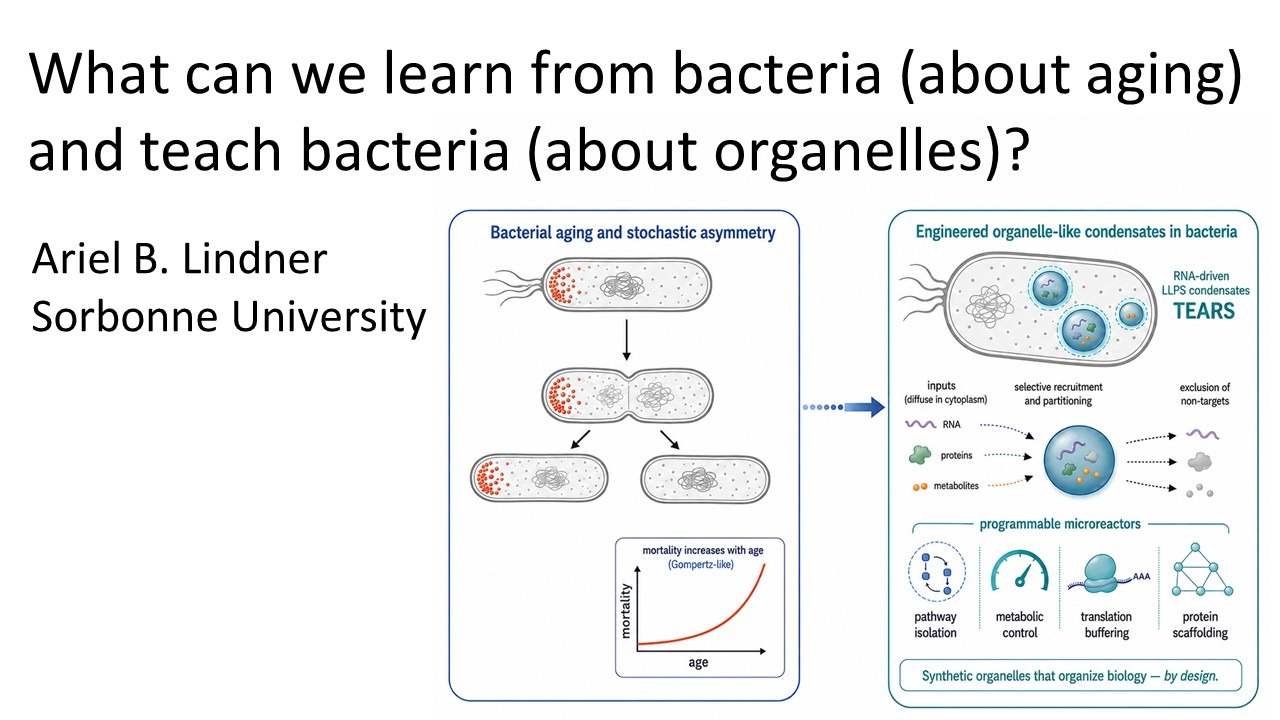
Even under constant genetic and environmental conditions, a population of cells is not a collection of identical dynamical systems. Molecular fluctuations and the imperfect partitioning of cellular components at division generate different trajectories from initially similar cells. In Escherichia coli, the apparently symmetric division of a cell can therefore produce a persistent functional asymmetry: one daughter preferentially inherits older cellular structures and damaged components, while the other is relatively rejuvenated.
Using time-lapse microscopy and microfluidic tracking of individual lineages, we examine how these microscopic asymmetries generate population-level patterns of senescence. Despite the simplicity of the organism, bacterial mortality can follow the Gompertz law: the instantaneous probability of death increases exponentially with age, just like humans. The rate of ageing is not fixed, however. Bacterial life history, blancing growth and investment in cellular maintenance rescale lifespan distributions, revealing a trade-off between growth, repair and survival. Bacteria thus provide a minimal experimental system in which to connect stochastic intracellular dynamics, symmetry breaking and selection to apparently universal laws of ageing.
In the second part of the talk, I will reverse the question and ask whether physical principles can be used to introduce new spatial organization into bacteria. We exploit multivalent RNA interactions and liquid–liquid phase separation to create genetically encoded, membraneless condensates called Transcriptionally Engineered Addressable RNA Solvent droplets, or TEARS. These droplets demix from the cytoplasm and act as programmable, compositionally selective microreactors. By controlling the partitioning of molecular components, TEARS can isolate biochemical pathways, redirect flux at metabolic branch points, buffer fluctuations in translation and scaffold protein interactions.
Together, these studies illustrate two complementary consequences of symmetry breaking in living matter: stochastic partitioning can generate ageing and rejuvenation, while engineered phase transitions can generate organelle-like spatial functions without membranes.