

Molecular rotors (MRs) are fluorescent molecules whose photophysical properties depend on their environment, making them valuable viscosity nanosensors. Interpreting their response in complex systems is challenging, however, since viscosity alone cannot describe such environments. This review covers the photophysical mechanisms behind MR viscosity sensitivity, the influence of chemical structure, and the Förster–Hoffmann relation and its limitations. It then surveys recent applications (Newtonian fluids, functional and composite materials, protein solutions), including polymer characterization, real-time monitoring of polymerization, and viscosity mapping. It also presents the thermal sensitivity of MRs as an advantage rather than a limitation, and concludes with structure-property relationships to guide the design of new rotors.
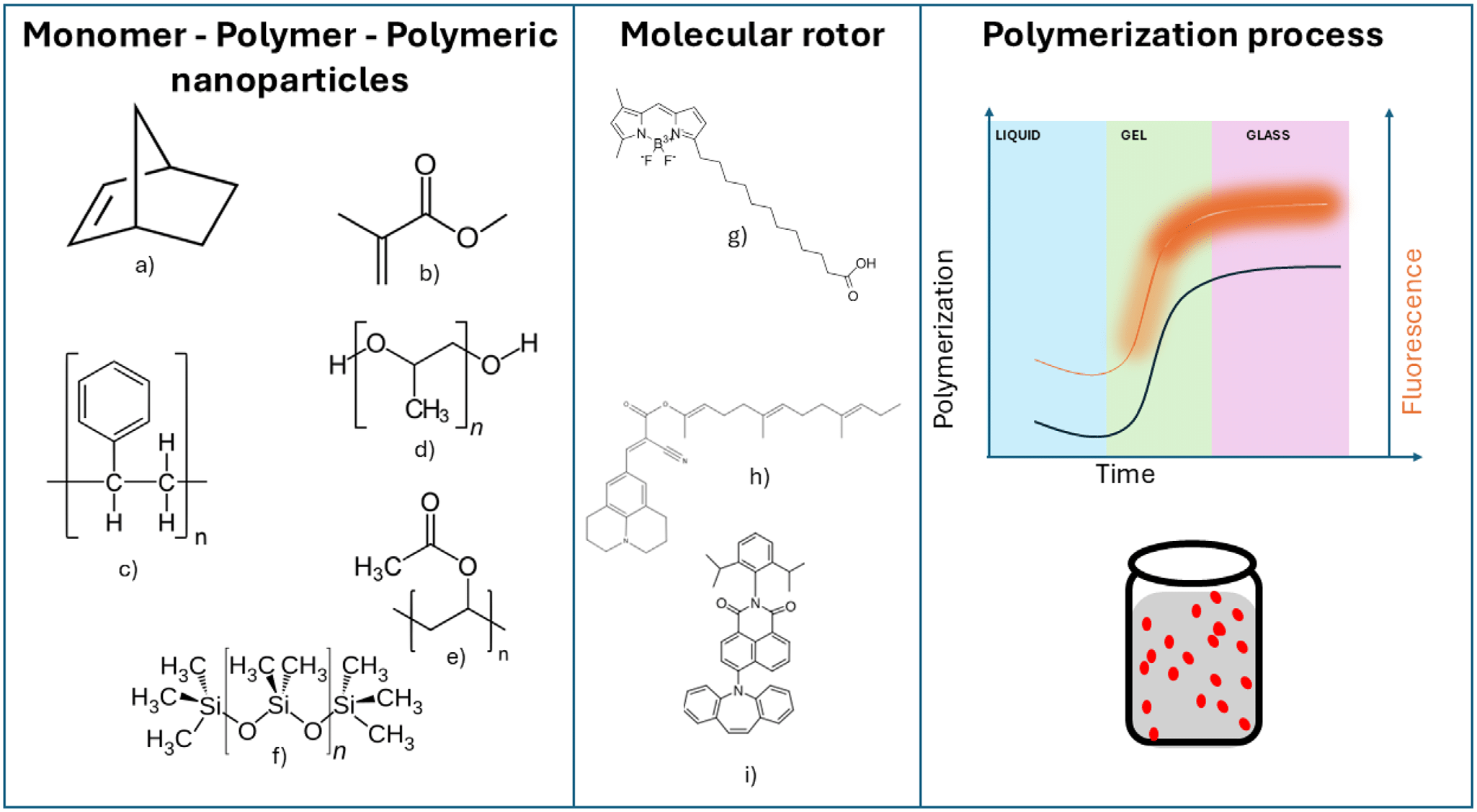
Figure: Representation of MRs embedded in NPs, polymer chains, and monomers to monitor the polymerization process.
Reference
Molecular Rotors: From Newtonian Fluids to Functional Materials as Viscosity and Temperature Sensing Tools, Flavia Di Scala, Alice Briole, Valerii Myndrul, Thomas J. Cleij, Hanne Diliën, Bérengère Abou, Bart van Grinsven, Advanced Functional Materials, 2026;0:e77541
https://doi.org/10.1002/adfm.77541